
SPF 30 vs SPF 50: What’s the Difference & Which One Should You Choose?

SPF 30 or SPF 50? Start with your day, not just the number.
SPF 50 has the bigger number. That doesn’t mean it’s automatically the better choice every morning.
A workday isn’t a beach day. A coffee run isn’t a three-hour hike. And the sunscreen you want on your face before work may not be the one you reach for before swimming or spending an afternoon outdoors.
So instead of asking, “Which SPF is better?” ask: “Which sunscreen fits my day?”
SPF30 vs SPF50 at a glance
First: what does SPF actually mean?
SPF stands for Sun Protection Factor. It mainly tells you how much protection a sunscreen provides against UVB — the ultraviolet radiation most closely associated with sunburn.
SPF 50 does provide more UVB protection than SPF 30, but it isn’t “almost twice the protection” simply because 50 is almost twice 30.
The difference matters, but it isn’t the whole sunscreen decision.
How much you apply, whether you apply it evenly, how long you stay outdoors, whether you swim or sweat, and whether you actually reapply can matter just as much in real life.
That’s why we don’t think choosing sunscreen should become a competition to buy the biggest number on the tube.
More SPF isn’t always more practical.

SPF30: the everyday option
Most days don’t involve six hours on a beach.
They involve walking to work. Driving across town. Grabbing lunch. Taking the dog out. Running errands. Sitting outside with a coffee. Moving between indoors and outdoors without really thinking about it.
That’s exactly the kind of routine our SPF30 was designed around.
Aussie Betta SPF30 uses a mineral sunscreen system and was developed as the lighter, everyday facial option in the range.
So if you’re looking for the sunscreen that naturally fits into your normal morning routine, SPF30 is likely where we’d tell you to start.
Think: commute, office, driving, errands, everyday walks and the ordinary stretches of sun exposure that happen as part of real life.
Not because SPF30 is an “indoor sunscreen.”
Because it was built around everyday facial use.
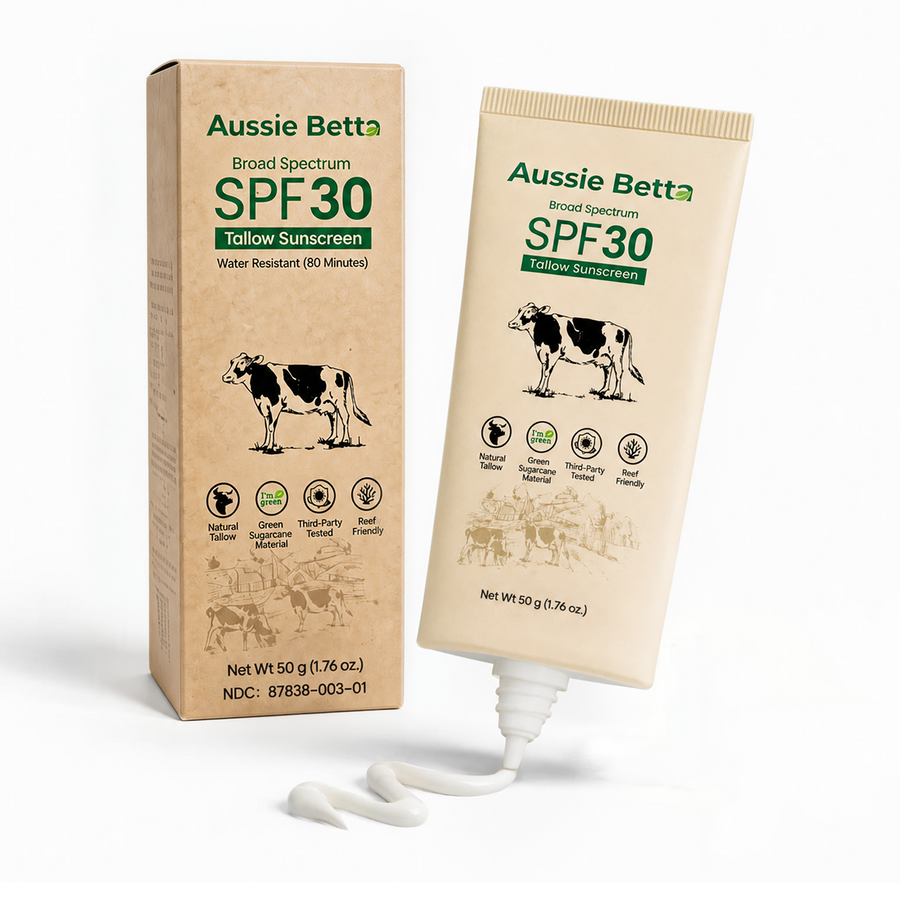
Everyday · Mineral · Facial wear
Aussie Betta Broad Spectrum SPF 30 Mineral Tallow Sunscreen for Face — 80-Min Water Resistant
$29.99
Explore SPF30SPF50: for the days that ask more from your sunscreen
Then there are the days when you already know you’re going to spend more time outside.
Beach days. Hiking. Swimming. Running. Outdoor sport. Summer travel. Long walks. Hours rather than minutes in the sun.
That’s where SPF50 starts making more sense.
Aussie Betta SPF50 uses a hybrid sunscreen system and was developed around higher SPF protection with practical face-and-body outdoor use in mind.
That doesn’t mean SPF50 has to stay in your beach bag.
It simply means that when you already know your day will involve more sustained sun exposure, the higher-SPF option has a clearer job to do.
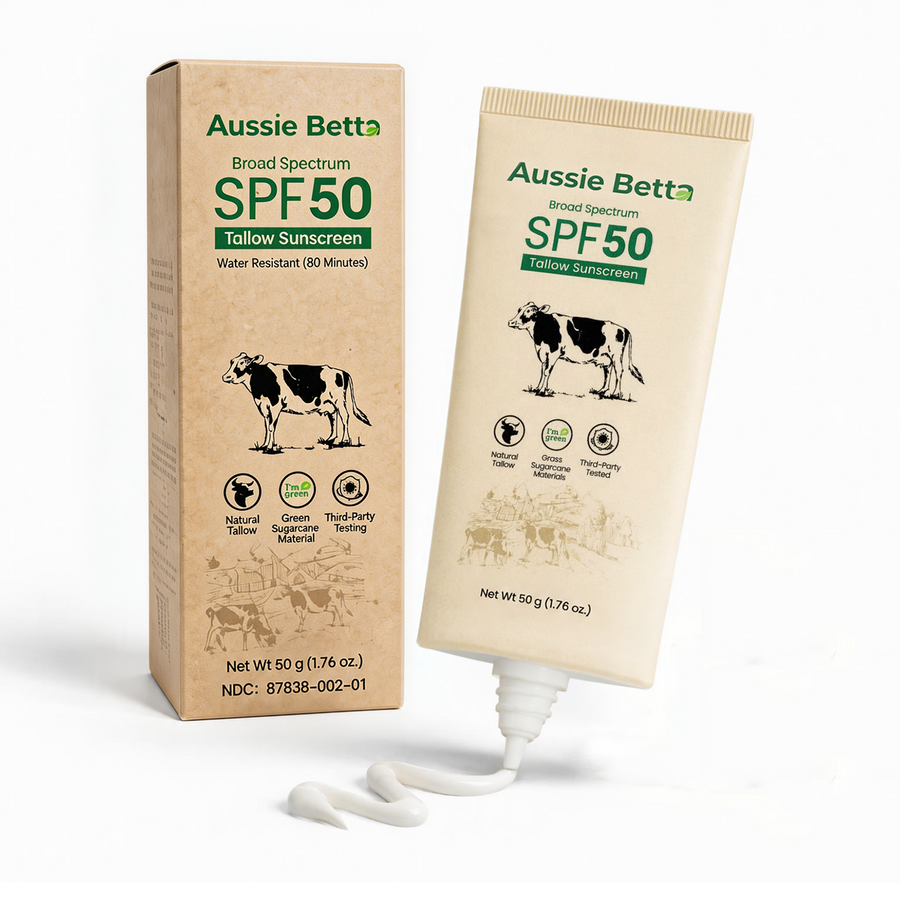
Longer Outdoor Days · Hybrid · Face + Body
Aussie Betta Broad Spectrum SPF 50 Hybrid Tallow Sunscreen for Face & Body — 80-Min Water Resistant
$32.99
Explore SPF50Mineral vs hybrid: the formulas are different for a reason
The difference between our SPF30 and SPF50 isn’t just the number printed on the tube.
They were formulated differently.
SPF30 takes a mineral approach. SPF50 uses a hybrid UV-filter system.
That difference reflects what each formula was built to do: SPF30 for everyday facial wear, and SPF50 for higher-SPF face-and-body use on longer outdoor days.
We don’t think that needs to become a debate where mineral sunscreen is labelled “good” and hybrid sunscreen “bad.”
They’re designed for different jobs.
If having a mineral formula is high on your list and you mainly want an everyday facial sunscreen, SPF30 makes sense.
If higher SPF and practical face-and-body use for longer outdoor days matter more, SPF50 becomes the more natural choice.
Different day. Different job. Different formula.
What if my skin tends to feel congested?
If your skin tends to feel congested — or you simply don’t enjoy richer sunscreen formulas on your face every day — don’t choose by SPF number alone.
SPF itself isn’t what determines whether a sunscreen feels heavy or works for breakout-prone skin. Formula and skin type matter.
In the Aussie Betta range, SPF30 was developed as the lighter everyday facial option, while SPF50 was built around higher protection, longer outdoor exposure and face-and-body use.
If most of your week is commuting, working and running errands, SPF30 may simply make more sense as your everyday choice — with SPF50 ready for the days that ask more from your sunscreen.
More SPF isn’t always more practical.

Protection is only half the story
A sunscreen can have an impressive SPF number and still end up untouched if it feels too greasy, heavy, drying or awkward under makeup.
That’s why these formulas were developed with skincare in mind too — pairing sun protection with ingredients selected around moisture, comfort and antioxidant support.
Tallow sits at the centre of that idea, alongside ingredients such as bisabolol, ferulic acid, ergothioneine and multiple forms of hyaluronic acid.
Sun protection should still remember that it’s sitting on your skin.
Give it a moment to settle
There’s another part of sunscreen nobody puts in the product title:
how you use it matters.
One of the most common mistakes is applying sunscreen and immediately layering makeup over it before the formula has had a chance to settle.
Our product-development team recommends allowing roughly 2–3 minutes for the formula to settle before continuing with makeup.
It’s a small thing, but it can make the routine feel much easier.
Apply it evenly.
Give it a moment.
Then move on with your morning.
No ten-step sunscreen ritual required.
Heading to the water? This is where testing matters.
Choosing sunscreen for a beach day or swim isn’t only about SPF.
Water exposure changes the equation too.
Both Aussie Betta sunscreens underwent independent human SPF testing by Intertek using an FDA SPF procedure that included an 80-minute water-immersion protocol.
The testing involved 10 human participants for each sunscreen.
That’s why swimming, sweating, towelling off and simply staying outside for hours still mean you need to think about reapplication.
We’ll go much deeper into the testing itself — who Intertek is, how human SPF testing works and what our results showed — in a separate article.

Independent SPF Testing
Intertek
Does SPF50 last longer than SPF30?
No.
A higher SPF doesn’t mean you can put sunscreen on once in the morning and forget about it until sunset.
Think of SPF50 as higher protection, not an all-day pass to stop thinking about sunscreen.
The days when you’re most likely to choose SPF50 — beach days, sport, swimming, hiking and long periods outdoors — are also the days when reapplication matters most.
So, SPF30 or SPF50?
You don’t need to turn this into a complicated decision.
If your normal day is mostly commuting, working, driving, running errands and shorter periods outside — and you like the idea of a mineral sunscreen designed around everyday facial wear — start with SPF30.
If you’re going to the beach, swimming, hiking, travelling, exercising outdoors or simply spending a lot more of the day under the sun — and you want the higher-SPF option for both face and body — reach for SPF50.
Sometimes SPF30 is exactly what your day needs.
Sometimes SPF50 makes more sense.
The goal isn’t to win a numbers game every morning.
It’s to choose the sunscreen that fits the day you’re actually about to have.
What does your day look like?
Everyday
SPF30 Mineral Tallow Sunscreen
- Everyday facial wear
- Mineral formula
- Commute, work, errands
Longer Outdoor Days
SPF50 Hybrid Tallow Sunscreen
- Face + body
- Hybrid formula
- Beach, pool, hiking, sport
Frequently Asked Questions
Is SPF50 better than SPF30?
SPF50 provides a higher level of UVB protection than SPF30, but “higher” doesn’t automatically mean it’s the most practical choice for every daily routine. Your time outdoors, activity, formula preference and how consistently you’ll wear the sunscreen all matter.
Is SPF30 enough for everyday use?
SPF30 can be a practical option for everyday wear when applied properly. In the Aussie Betta range, SPF30 is specifically positioned as the everyday facial option.
Should I use SPF30 or SPF50 on my face?
Both can be used on the face depending on the formula and what you’re doing. Aussie Betta SPF30 is designed primarily around everyday facial wear, while SPF50 is designed for face and body and for days involving more sustained outdoor exposure.
Can SPF50 clog pores or cause breakouts?
SPF50 itself isn’t what determines whether a sunscreen clogs pores. Formula and individual skin type matter more.
Within the Aussie Betta range, SPF30 is the lighter everyday facial option, while SPF50 has a more outdoor-focused role.
What’s the difference between mineral and hybrid sunscreen?
Mineral sunscreen uses mineral UV filters, while a hybrid sunscreen combines mineral and non-mineral UV filters.
Aussie Betta SPF30 uses a mineral system, while SPF50 uses a hybrid formula developed around higher-SPF outdoor face-and-body use.
Should I use SPF50 at the beach?
A higher-SPF, water-resistant sunscreen is a sensible choice when you expect longer sun exposure, swimming or sweating. Sunscreen still needs to be reapplied according to its directions, especially after water exposure.
Does SPF50 last longer than SPF30?
No. A higher SPF does not mean the sunscreen lasts longer before reapplication.
What does 80-minute water resistance mean?
An 80-minute water-resistance test evaluates SPF performance after a defined series of water-immersion cycles totalling 80 minutes.
It does not mean sunscreen is waterproof or that it never needs to be reapplied.
Can I wear sunscreen under makeup?
Yes. With these formulas, allowing the sunscreen a couple of minutes to settle before moving on to makeup can help the layers sit more naturally.